
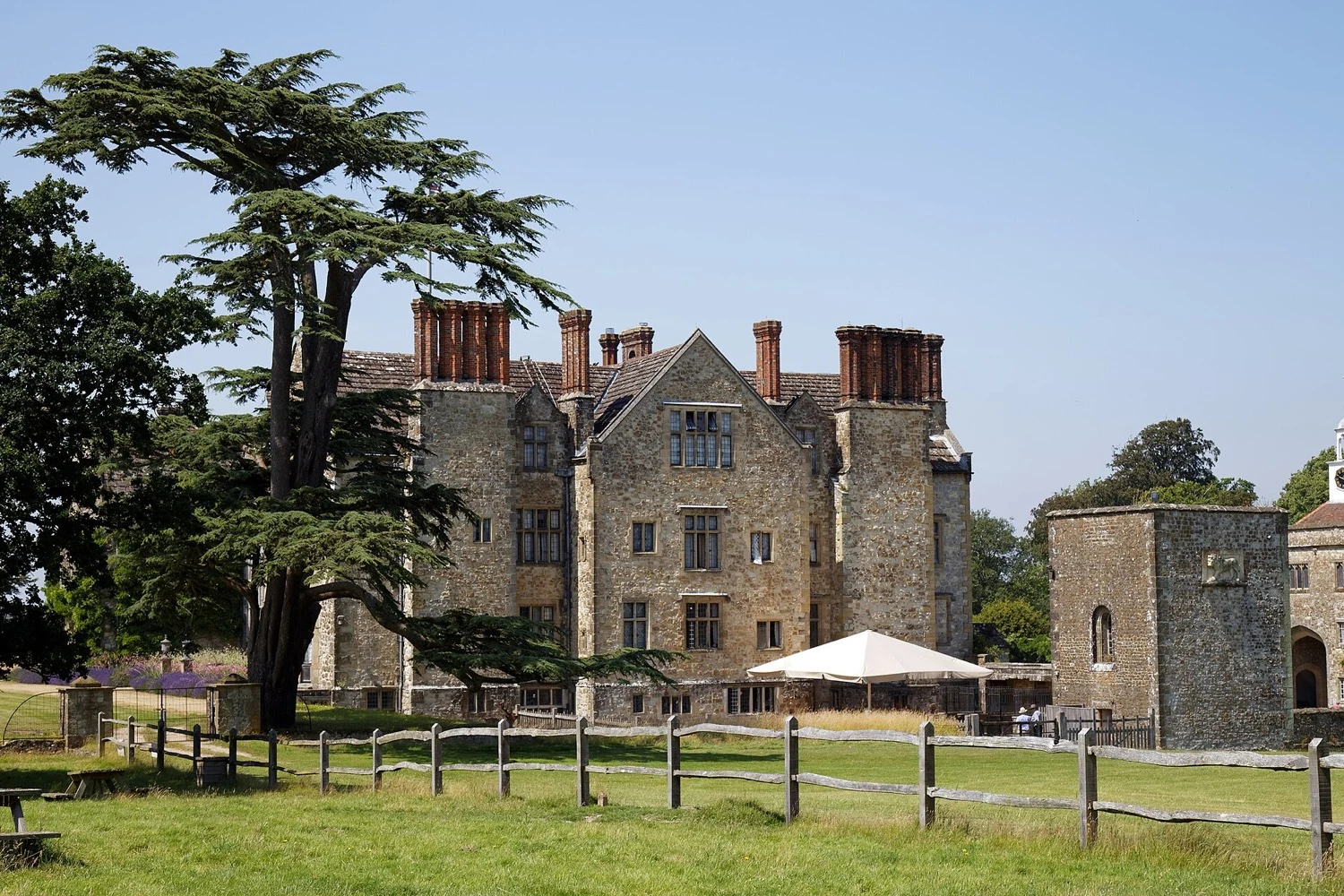
Nestled at the foot of the South Downs, in West Sussex, Parham House is one of the most charming Elizabethan houses in England. Built on former monastic lands, it unfolds its long gallery and its great hall with the intact serenity of a late-sixteenth-century house — and a delightful foundation legend.
A prodigy house on monastic lands
The manor of Parham had been granted in 1540 to the Palmer family, in the wake of the Dissolution of the Monasteries: like so many others, these Church lands passed to a rising family. It was there that Robert Palmer undertook, from 1577, to build a great country house — an Elizabethan 'prodigy house', with its south front in an E-plan (a discreet homage to Queen Elizabeth), its great hall and above all its long gallery of nearly 48 metres, made for walking, conversation and the display of family portraits. The house was sold in 1601 to the Bisshopps, who held it long.
A child's foundation stone
A pretty custom attaches to Parham a founding anecdote. On 28 January 1577, the foundation stone of the house was laid not by the master builder nor by the head of the family, but by Thomas Palmer, then about two and a half years old: custom indeed had it that the youngest member of the household symbolically lay the first stone, to bind the longevity of the line to that of the house. Thus a great Elizabethan house was inaugurated by the hands of an infant. To see: the Grade I listed house with its E-plan south front, the Long Gallery, the Great Hall and its sixteenth-century portraits, the embroidery collections, the formal gardens and the deer park.
Did you know?
The foundation stone of Parham was laid by a child of two and a half: by an Elizabethan custom, it fell to the youngest of the household to perform this act, so that the house might last as long as the life that was beginning. Little Thomas Palmer thus inaugurated, in 1577, a house that would outlive him by several centuries.
Notes
Parham House lies near Storrington, West Sussex, at the foot of the South Downs; house and gardens open to the public. Seasonal hours to check.
Quiz
- What does Parham's 'E-plan' south front signify?
- A discreet homage to Elizabeth (E)
- An architect's mistake
- A defensive plan
- Who laid the foundation stone in 1577?
- Thomas Palmer, a child of about two and a half
- The queen in person
- The Archbishop of Canterbury
- Where did Parham's lands come from?
- Former monastic lands granted in 1540
- A Norman conquest
- A purchase from the French