
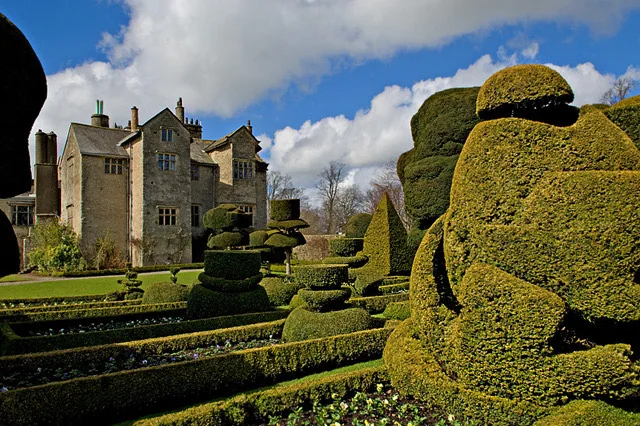
South of Kendal, in Cumbria, Levens Hall is the largest Elizabethan house in the county: a grey-stone house born, like so many northern houses, around an old defensive tower, and transformed in the Renaissance into a comfortable, adorned residence.
From a strong tower to an Elizabethan house
The core of Levens is a medieval pele tower, a watch-tower of the border country. Around 1580, James Bellingham enlarged it and transformed it into a great Elizabethan house, to which he gave rich interiors: carved panelling, plaster ceilings, wrought chimneypieces — a late-sixteenth-century decor remarkably well preserved. Look at this woodwork and plasterwork: it ranks among the finest Elizabethan interiors of the North-West.
The oldest topiary garden
Levens is world-famous for its topiary garden — yews and box clipped into fantastic shapes, pyramids, hats, chessboards. Mind the date: this garden was created in 1694 by Guillaume Beaumont, gardener to James II, for Colonel Grahme, so AFTER our Renaissance period; but it belongs to the same place and is the oldest surviving topiary garden in the world. The house itself remains the Elizabethan heart. Don't miss: the front and the tower, the Elizabethan interiors (panelling, plasterwork), the topiary garden (later), the park.
Did you know?
Levens Hall unites two ages within one enclosure: an Elizabethan house of the 1580s, and the oldest topiary garden in the world, planted a century later, in 1694. The clipped yews admired today are thus more than three centuries old — not reconstructions, but the same trees, clipped without a break since the reign of William III.
Info
Levens Hall is near Kendal (Cumbria); a private house, house and gardens open to the public in season. Hours to be checked.