
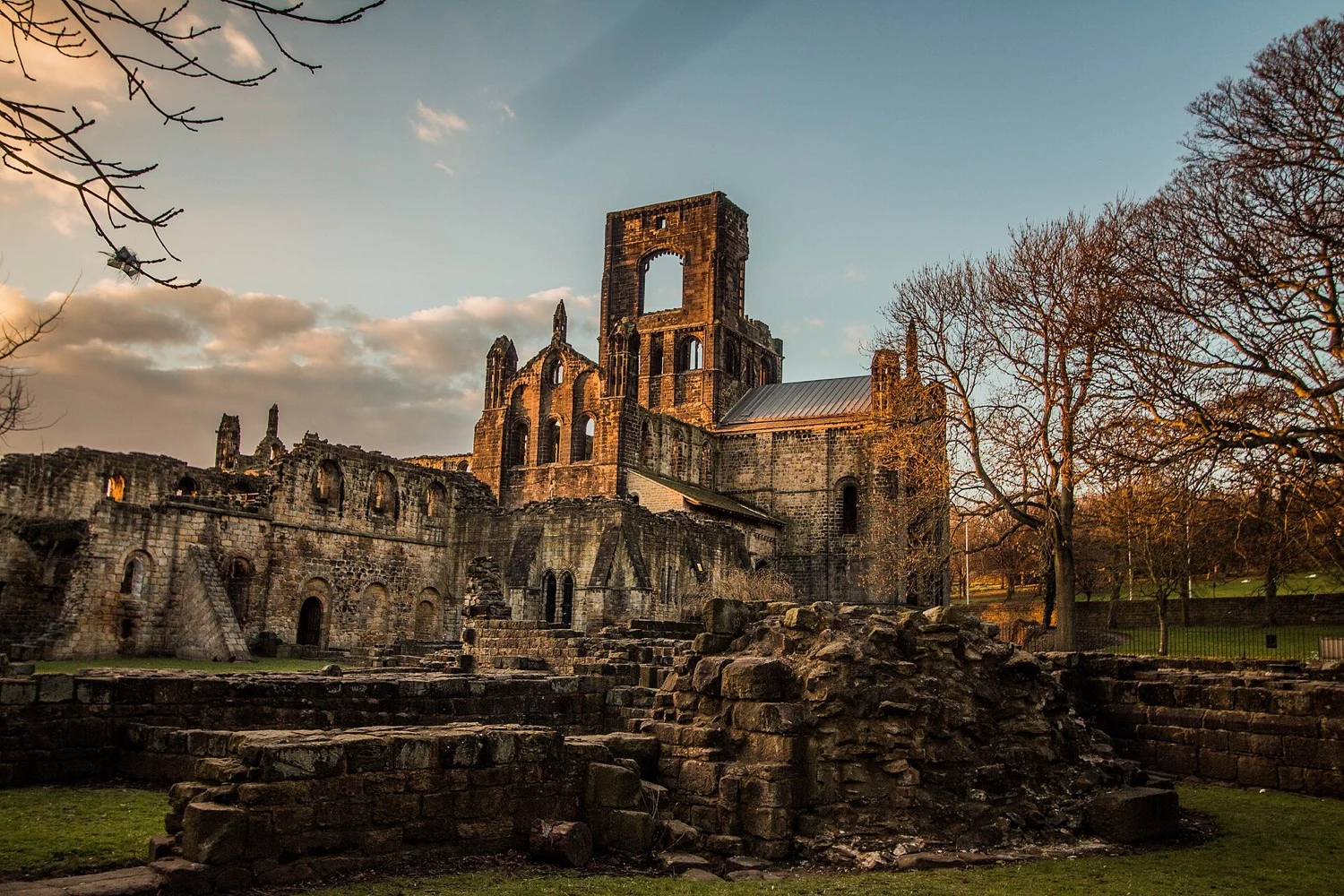
In the suburbs of Leeds, in West Yorkshire, the vast ruins of Kirkstall Abbey rank among the best preserved of Cistercian architecture in England. Its surrender in 1539 illustrates the Dissolution of the Monasteries — and its later destiny, the abrupt religious reversals of the mid-sixteenth century.
A great Cistercian abbey dissolved
Kirkstall was a great Cistercian abbey. Its surrender, on 22 November 1539, is part of the wave of Dissolution of the Monasteries led by Henry VIII: everywhere, the great monastic houses were closed, their property confiscated, their communities dispersed. Kirkstall keeps substantial remains — the church, the chapter house, the cloister, the refectory, the lay brothers' dormitory — that give a striking idea of what a great northern monastery was before its closure. Its ruins bear witness to the fate of these age-old communities swept away in a few years.
A telling round trip
Kirkstall's destiny after the Dissolution sums up the religious reversals of the mid-century. In 1542, the estate was granted to Archbishop Thomas Cranmer, the very architect of the English Reformation, author of the Book of Common Prayer. But in 1556, under the Catholic reign of Mary I, Cranmer was burned as a heretic — and, at his execution, the estate returned to the Crown. It was finally bought in 1584 by Sir Robert Savile, whose family kept it for nearly a century. This back-and-forth — granted to a reformer, taken back at his death by a Catholic queen — illustrates to perfection the religious instability of mid-sixteenth-century England. To see: the substantial remains of the church, the chapter house, the cloister and the refectory, the lay brothers' dormitory, the gatehouse turned into the Abbey House Museum.
Did you know?
Kirkstall was given to Thomas Cranmer in 1542, then 'taken back' by his own death: the archbishop who had organised the Dissolution of the Monasteries and written the English liturgy ended at the stake in 1556, a victim of the return to Catholicism under Mary I. The man who had done so much to transform the Church of England perished in the flames, and the abbey given to him returned to the Crown — as if history were taking back its gifts.
Notes
Kirkstall Abbey lies at Kirkstall, Leeds, West Yorkshire; ruins and Abbey House Museum open to the public (run by the city of Leeds). Hours to check.
Quiz
- When was Kirkstall Abbey dissolved?
- In 1539 (Dissolution of the Monasteries)
- In 1066
- In 1605
- To which reformer was the estate granted in 1542?
- Archbishop Thomas Cranmer
- John Knox
- Thomas More
- Why did it return to the Crown in 1556?
- Cranmer was executed under Mary I
- A fire
- A sale