
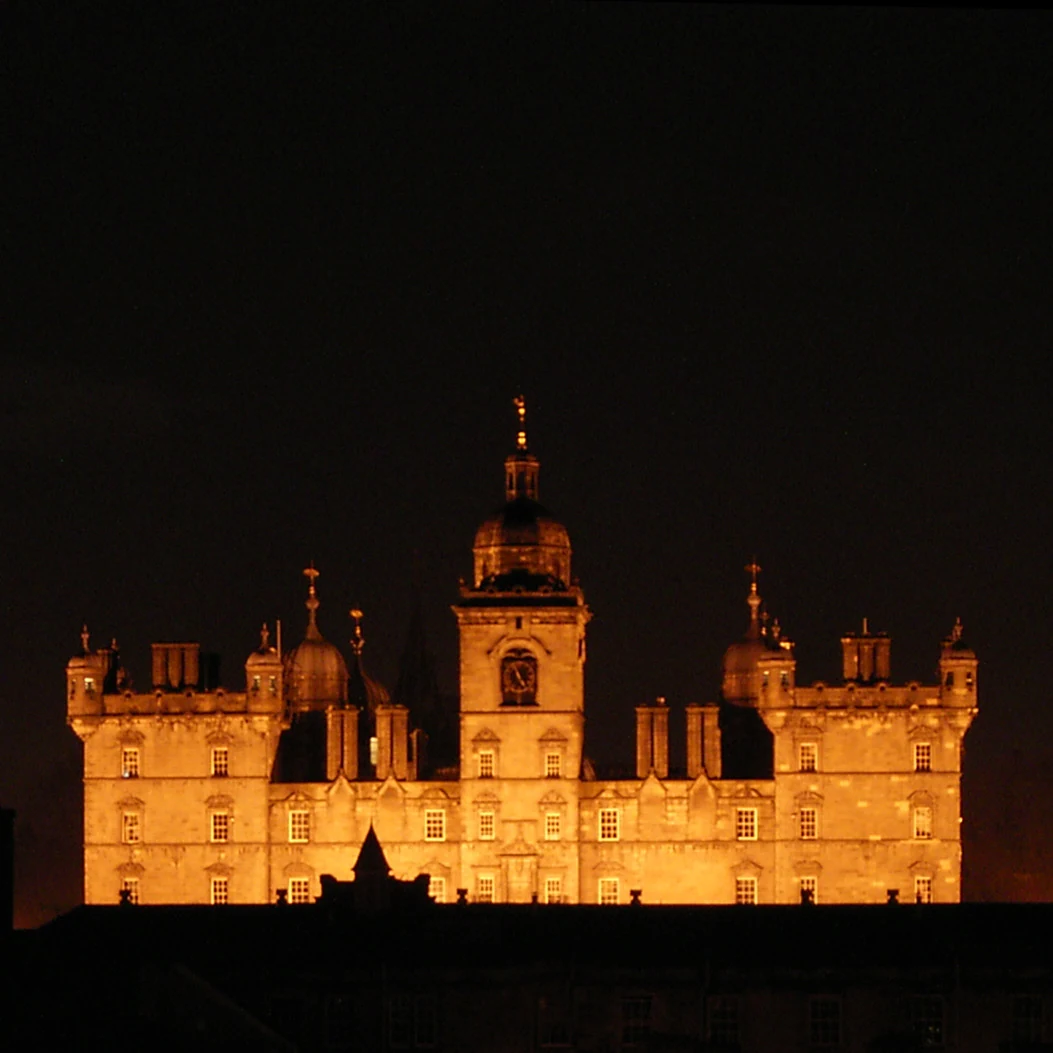
Below Edinburgh Castle stands one of the finest buildings of the Scottish Renaissance: a great quadrangular pile bristling with turrets and dormers, built not for a prince but for the poor children of the city — through the fortune of a goldsmith.
A palace for orphans
George Heriot (1563-1624), nicknamed "Jinglin' Geordie", was goldsmith and moneylender to King James VI of Scotland (who became James I of England). At his death he left his vast fortune to found a "hospital" — an orphanage-school — for the needy sons of Edinburgh burgesses. Built between 1628 and 1659, it is a palatial building set around a square court: look at the four corner towers, the profusion of mullioned windows, the wrought pediments and the monumental entrance. No two windows, it is said, are exactly alike — a decorative tour de force.
An architecture of transition
George Heriot's weds the Scottish tradition of towers to a Renaissance vocabulary from the continent: a symmetrical plan and classical ordering of the fronts, yet a skyline still bristling in the Scots manner. The building became a model for the city's public architecture. It is still a school today. Don't miss: the inner court with the founder's statue, the corner turrets, the chapel, and the fronts whose windows are all different.
Did you know?
Walter Scott made "Jinglin' Geordie" a character in his novel The Fortunes of Nigel: the nickname is said to come from the sound of gold coins the goldsmith-lender jingled in his pockets. The man who lent to a king left his fortune to orphans — and his school still teaches pupils four centuries on.
Info
George Heriot's School stands on Lauriston Place, Edinburgh, below the Castle; a working school, court and exterior visible (interior access limited). Hours to be checked.