
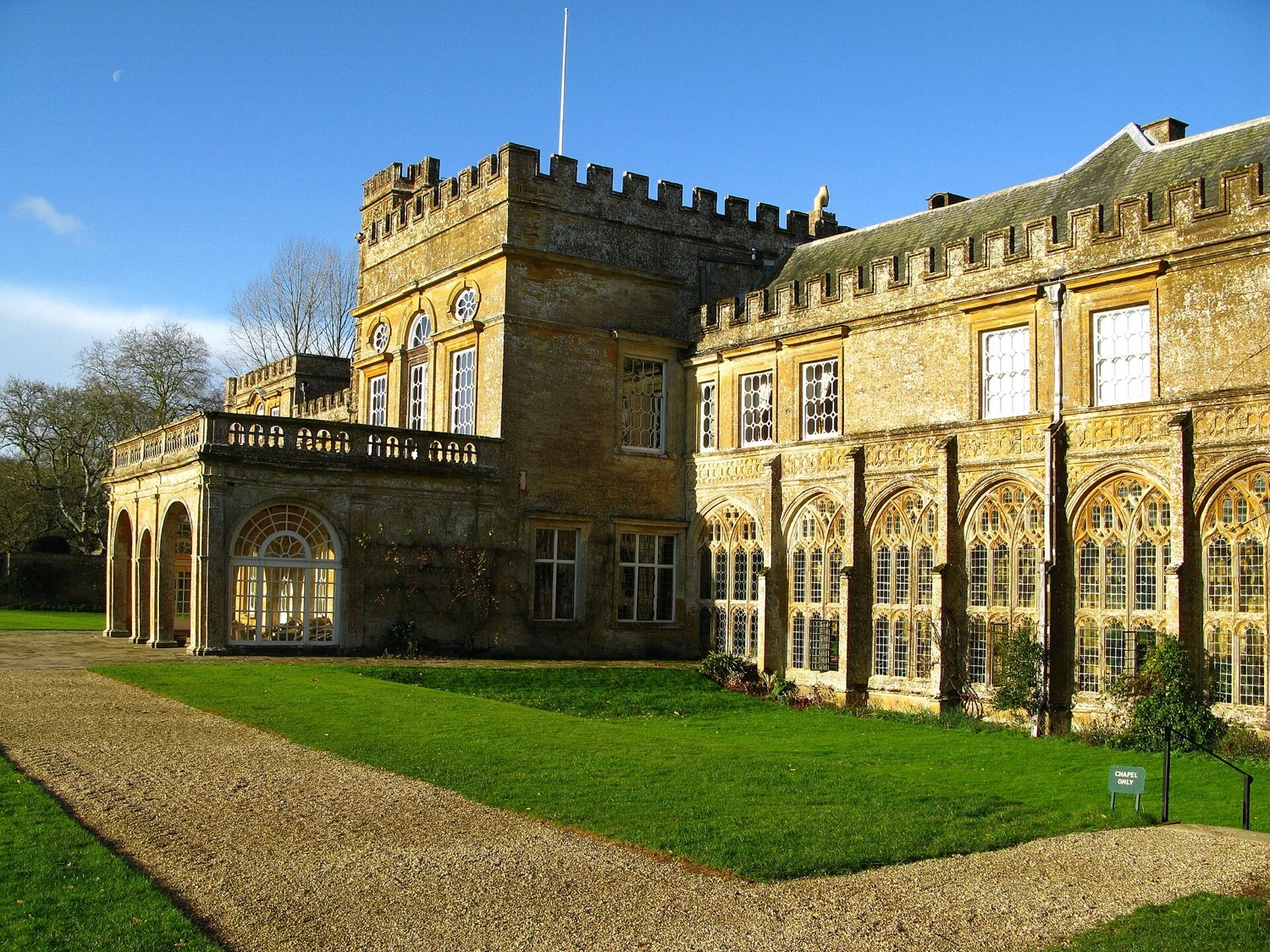
On the border of Dorset and Somerset, in a green valley, Forde Abbey joins the serenity of a former monastery to the pleasure of a house surrounded by gardens. Its history carries a poignant irony: the abbey was sumptuously embellished by its last abbot, barely a few years before the Reformation carried it off.
The irony of the last abbot
Forde was a rich Cistercian abbey, founded in the twelfth century. On the eve of the Reformation, its last abbot, Thomas Chard, a cultivated man and a builder, set out to magnify it: he had raised, in the 1520s-1530s, a great hall, an entrance tower and richly adorned lodgings, in the early Renaissance style. Barely were these embellishments finished when the dissolution of the monasteries struck: in 1539 Forde was suppressed, its monks dispersed. The abbot had thus spent a fortune to embellish a monastery that would vanish almost at once — a poignant symbol of a world still building as it reached its end.
From an abbey to a house of gardens
After the Dissolution, Forde passed to lay owners who, rather than demolish it, gradually turned it into a house, keeping a great part of the monastic buildings: the cloister, the chapter house, Abbot Chard's great hall. In the seventeenth century the house was refitted with splendour. But Forde is above all famous today for its magnificent gardens — stretches of water, a cascade, an arboretum, parterres — that make it one of the finest landscape ensembles in the South West. The old Cistercian monastery, once vowed to silence and the working of the land, has thus become, by a fitting return, a place where the art of the garden reigns supreme.
What to see
- The great hall and tower of Abbot Thomas Chard (1520s-1530s).
- The preserved monastic buildings (cloister, chapter house).
- The famous gardens (water features, cascade, arboretum).
- The setting of the valley, on the border of Dorset and Somerset.
Did you know?
Abbot Thomas Chard had the sad privilege of magnificently embellishing his abbey just before losing it: his splendid additions, completed around 1530, served worship only a few years before the Dissolution of 1539. Chard, a shrewd man, nonetheless negotiated a comfortable pension and ended his days peacefully. His great hall, for its part, came down the centuries — so that the finest legacy of monastic life at Forde was, paradoxically, the work of its last abbot, on the eve of the end.
Practical information
Forde Abbey lies near Chard, on the border of Dorset and Somerset, in the south-west of England. It is a private house, open to the public with its famous gardens. Opening hours and days are liable to change with the seasons; it is best to check them against the official sources before visiting.
Quiz
- Who sumptuously embellished Forde just before the Dissolution?
- The last abbot, Thomas Chard
- Henry VIII
- Robert Smythson
- What did Forde Abbey become after 1539?
- A house keeping the monastic buildings
- A military fortress
- A cathedral
- What is Forde Abbey above all famous for today?
- Its magnificent gardens
- Its gold mines
- Its Roman theatre