
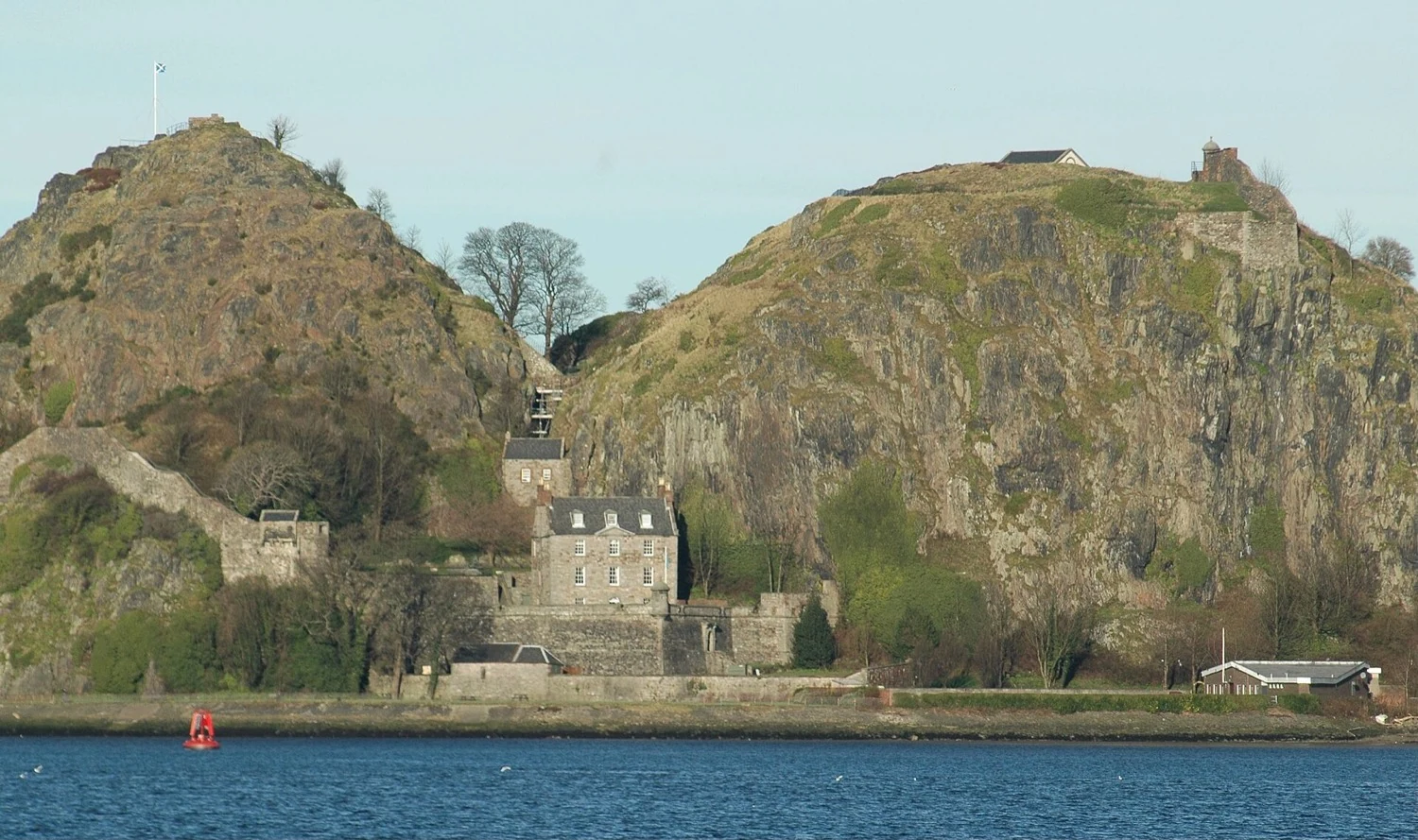
On Dumbarton Rock, a twin volcanic crag dominating the Clyde, Dumbarton Castle has watched over the west of Scotland for centuries. An impregnable royal fortress, it was the starting point of Mary Stuart's destiny: it was from here that the little queen, aged five, embarked for France in 1548.
The royal lock of the west
Dumbarton was one of the great royal fortresses of Scotland, guarding the estuary of the Clyde and access to the west of the realm. Perched on its spectacular rock, it was reckoned impregnable. In 1503, James IV gave it to his young wife Margaret Tudor; in 1540, James V landed there during his tour of Scotland with Cardinal Beaton. A maritime and military base, Dumbarton was an essential link in the defence and prestige of the Crown in the west.
The departure of Mary Stuart
The great moment of Dumbarton is the departure of Mary Stuart for France. After the ravages of the 'Rough Wooing' (the English attempt to impose by force Mary's marriage to the future Edward VI), the little queen was put in safety at Dumbarton, then embarked on 13 August 1548, at five years old, for France — accompanied by her governess Lady Fleming and the famous 'Four Marys', her four maids of honour. The fleet went round Ireland to avoid the English ships. Mary would grow up at the French court, marry the dauphin, and return to Scotland only in 1561, a widow and a queen. The governor John Fleming later defended Dumbarton for Mary during the Marian civil war, until its spectacular capture in 1571. To see: the portcullis arch (fourteenth century), the foundations of the Wallace Tower, the sixteenth-century gatehouse, the climb (627 steps) to the White Tower and the panorama over the Clyde.
Did you know?
The 'impregnable' fortress of Dumbarton was taken in 1571 by an astonishing audacity: the men of the regent Lennox scaled by night, with ladders, the sheer face of the rock reckoned inaccessible, and seized by surprise the garrison that held the stronghold for Mary Stuart. It is told that a soldier, seized by vertigo or convulsions halfway up, had to be tied to the ladder and gone round by his companions. The fall of Dumbarton, a coup de théâtre of the civil war, showed that no fortress was truly impregnable.
Notes
Dumbarton Castle lies at Dumbarton, on Dumbarton Rock (Clyde), West Dunbartonshire; a fortress run by Historic Environment Scotland, open to visits (steep climb). Seasonal hours to check.
Quiz
- From where did Mary Stuart embark for France in 1548?
- From Dumbarton Castle
- From Dover
- From Edinburgh
- Who accompanied her?
- Lady Fleming and the 'Four Marys'
- John Knox
- Henry VIII
- How was the 'impregnable' fortress taken in 1571?
- By a night climb of the rock
- By famine
- By betrayal of the gates