
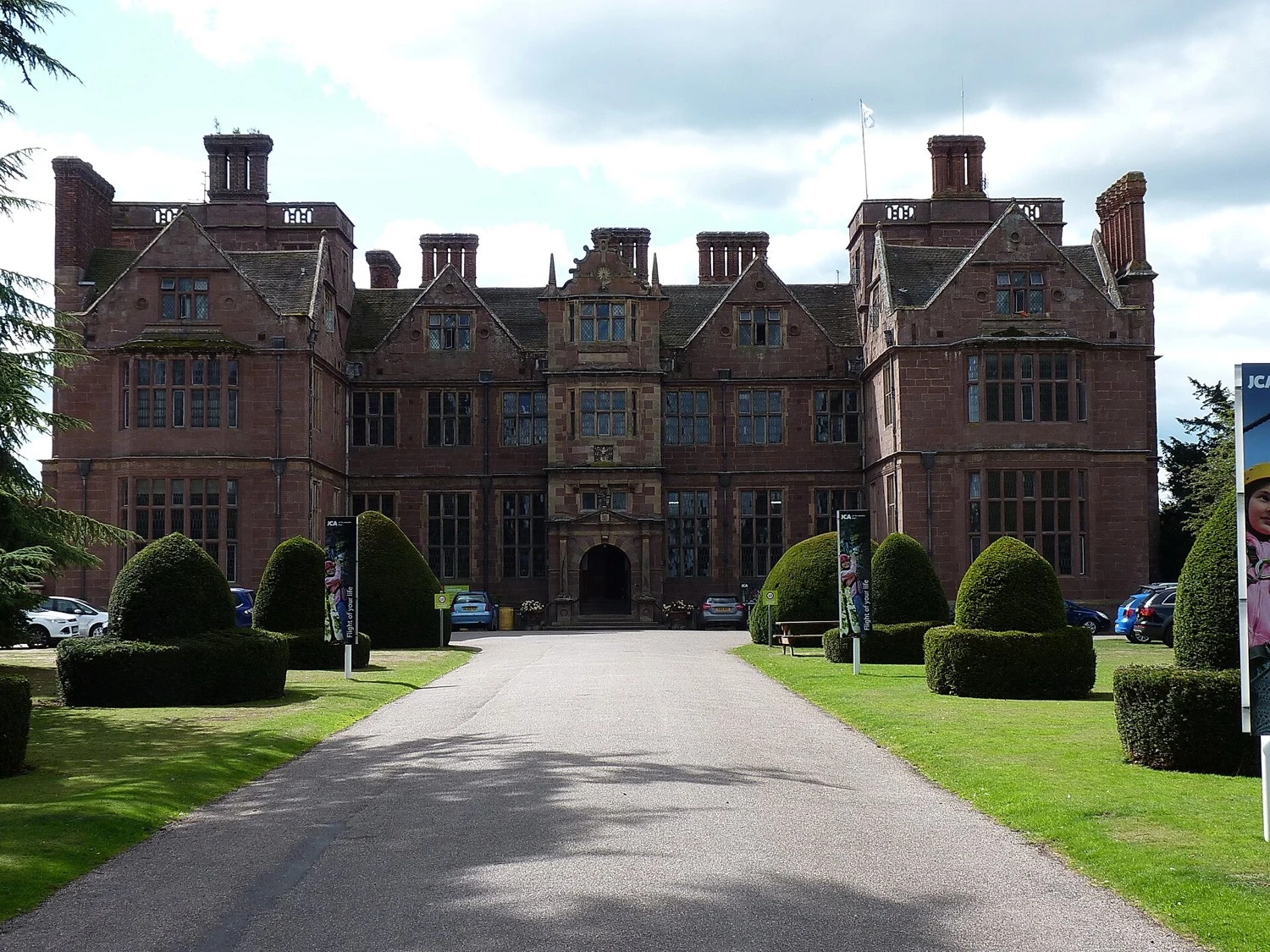
South of Shrewsbury, Condover Hall spreads a majestic front of pink sandstone on an H-plan: it is one of the finest and most complete of the great Elizabethan houses of Shropshire, kept almost as it was built, in the late sixteenth century.
A great stone house on an H-plan
Condover was built from 1586 to 1598 for Thomas Owen, a judge of the Court of Common Pleas. Unlike the brick Midlands, here wealth is displayed in the local pink sandstone, superbly cut. Look at the H-plan — a central range and two wings — and the careful symmetry of the front, the mullioned windows, the shaped gables, the chimneys. The whole gives a rare impression of unity: one campaign, one design, without the reworkings that blur so many other houses.
A house that kept its face
Because it changed little, Condover is a full-scale textbook of Elizabethan architecture: one reads clearly in it the passage to the house of prestige, open, regular, turned towards the garden rather than defence. The house served as a school, then an activity centre; the park and exteriors can be seen. Don't miss: the pink sandstone front, the H-plan, the gables and chimneys, the park.
Did you know?
The colour of a great English house betrays its geology: red brick where clay abounds and stone is scarce (East Anglia, the Midlands), pale limestone in the Cotswolds, pink sandstone in Shropshire and the Welsh Marches. Condover is pink because the ground is: the English Renaissance built, region by region, with whatever the earth offered underfoot.
Info
Condover Hall is at Condover, south of Shrewsbury (Shropshire); used as a residential centre; exteriors visible from the approaches, interior not freely open. Access to be checked.