
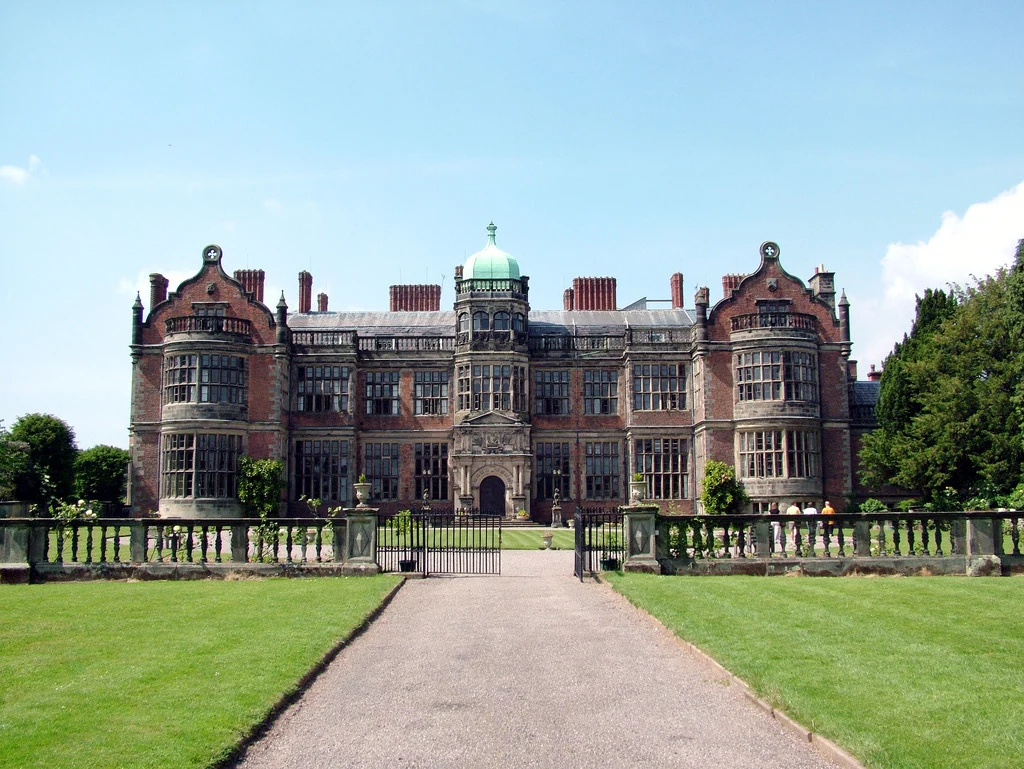
In the Staffordshire countryside, Ingestre Hall shows a long front of rose brick punctuated with gables and tall wrought chimneys: a Jacobean house of 1613, long the seat of one family, the Chetwynds, then the Talbots, Earls of Shrewsbury.
A Jacobean house of 1613
Ingestre was built in 1613 for Sir Walter Chetwynd, sheriff of the county, on the site of an older manor he pulled down. Look at the front: rose brick and pale stone dressings, mullioned and transomed windows, decorative chimneys, gables — it is the vocabulary of the Jacobean house, that late phase of the English Renaissance under James I, where Elizabethan symmetry grows heavy with ornament. The house was reworked in the early nineteenth century, but keeps its 1613 heart.
The church of the late Renaissance
Just beside it stands St Mary's church, rebuilt around 1673-76, often attributed to Christopher Wren — one of the rare examples of his art outside London, and a sign that the family followed the new fashion. The house, after a fire and restorations, now belongs to a local authority and serves as a residential arts centre for young people. Don't miss: the Jacobean brick front, the chimneys and gables, the neighbouring church, the park.
Did you know?
Brick, at Ingestre as across the English heartland, is no poor man's material: in the sixteenth and seventeenth centuries, in a region without good building stone, well-fired brick, laid in fine bonds and set off with pale stone at the corners, was a luxury and a mark of modernity. The great Jacobean houses of the Midlands made it their signature.
Info
Ingestre Hall is at Ingestre, near Stafford (Staffordshire); owned by a local authority, run as a residential arts centre; visits of the exterior and church on certain days. Access to be checked.