
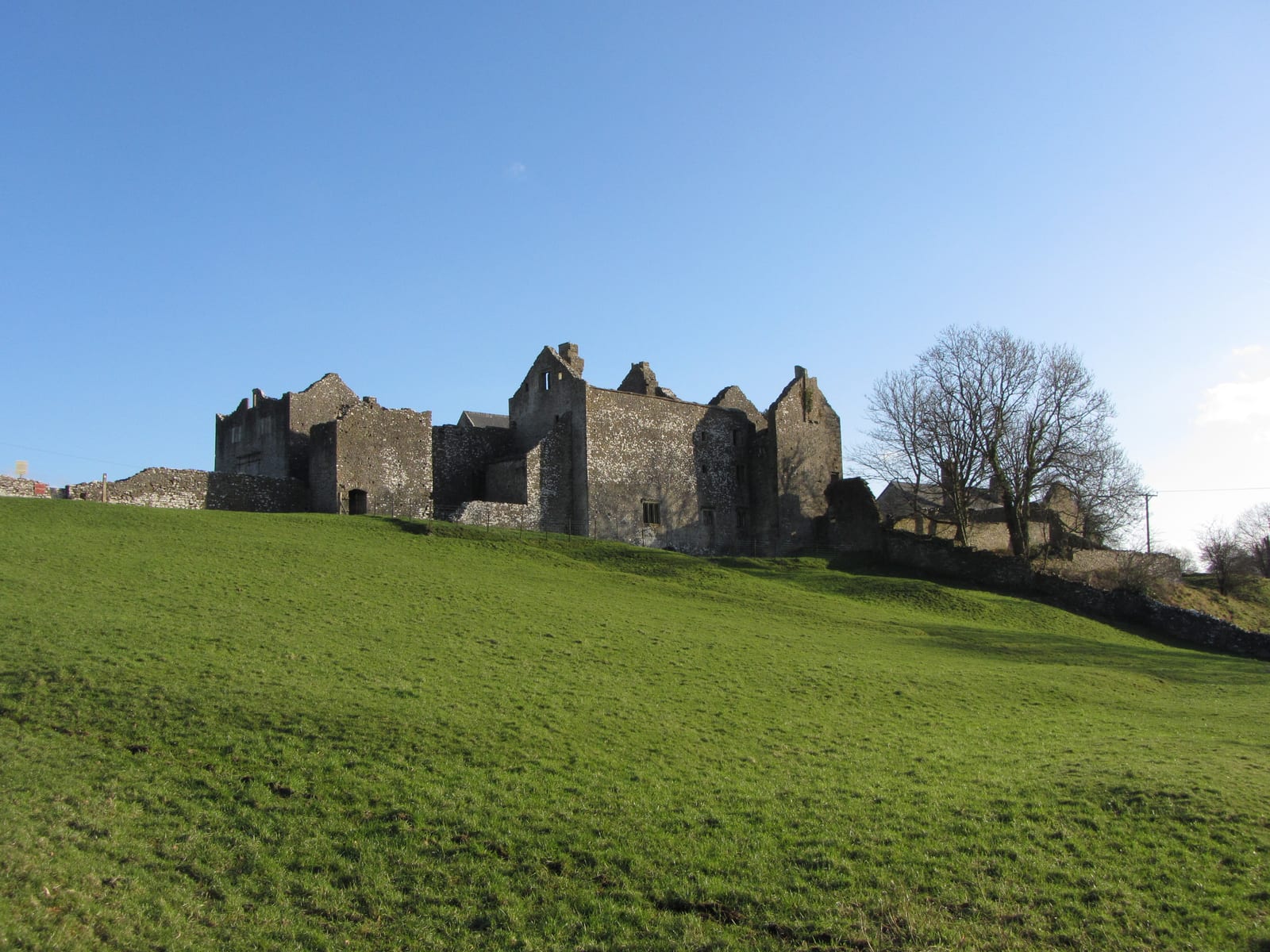
In the hollow of the Vale of Glamorgan countryside, the ruins of Old Beaupre keep an unexpected treasure: a Renaissance porch with superimposed columns, a jewel of antique ornament lost deep in the Welsh fields. This manor of the Bassett family shows how the new language of the Renaissance reached even the rural houses of Wales.
The manor of the Bassetts
Beaupre (also written Beaupré, 'fair place') was the manor of the Bassett family, gentlemen of Glamorgan. In the sixteenth century, prosperous and eager to display their taste, the Bassetts transformed and enlarged their old medieval house, adorning it with elements in the then-fashionable Renaissance style. The house, arranged around courts, blended the traditional structure of the Welsh manor and the new ornaments come from the Continent. Now a ruin, it still lets this ambition be read: that of a provincial family which wanted, too, to speak the learned language of its century.
An antique porch
The marvel of Beaupre is its entrance porch (around 1600), a rare work in Wales: three levels of superimposed columns — Doric, Ionic, Corinthian — according to the rules of the classical orders of antiquity, surmounted by the family's arms. This porch is a manifesto: through this antique vocabulary, the Bassetts proclaimed their knowledge of the Italian architectural treatises and their belonging to the culture of the Renaissance. That such refinement should be found in an isolated Glamorgan manor says how far the new language had penetrated, by the end of the sixteenth century, even into the Welsh countryside. Beaupre in ruins thus remains one of the most precious — and most moving — witnesses of the Renaissance in Wales.
What to see
- The Renaissance porch with its three orders of superimposed columns.
- The arms of the Bassetts crowning the porch.
- The ruins of the manor arranged around its courts.
- The rural, isolated setting of the Vale of Glamorgan.
Did you know?
The porch of Beaupre scrupulously applies the rule of the 'orders' of classical architecture: the Doric (the plainest) at the bottom, the Ionic in the middle, the Corinthian (the most ornate) at the top — exactly as the Italian Renaissance treatises taught, inherited from Roman antiquity. To see this learned grammar raised deep in a Welsh field has something moving about it: it is proof that a provincial gentleman, far from everything, had read his architecture books and wanted, over his door, to show that he belonged to the great century of the arts.
Practical information
Old Beaupre (Beaupre Castle) lies near Cowbridge, in the Vale of Glamorgan, in the south of Wales. It is today a ruin in the care of Cadw (the Welsh heritage service), generally in free access (at the end of a footpath). The arrangements and state of access are liable to change; it is best to check them against the official sources before visiting.
Quiz
- What is the treasure of Old Beaupre?
- A Renaissance porch with three orders of columns
- A gilded dome
- An intact keep
- Which family adorned Beaupre in the Renaissance style?
- The Bassetts
- The Stradlings
- The Tudors
- In which order are the porch's columns superimposed?
- Doric, Ionic, Corinthian
- All Corinthian
- In no particular order