
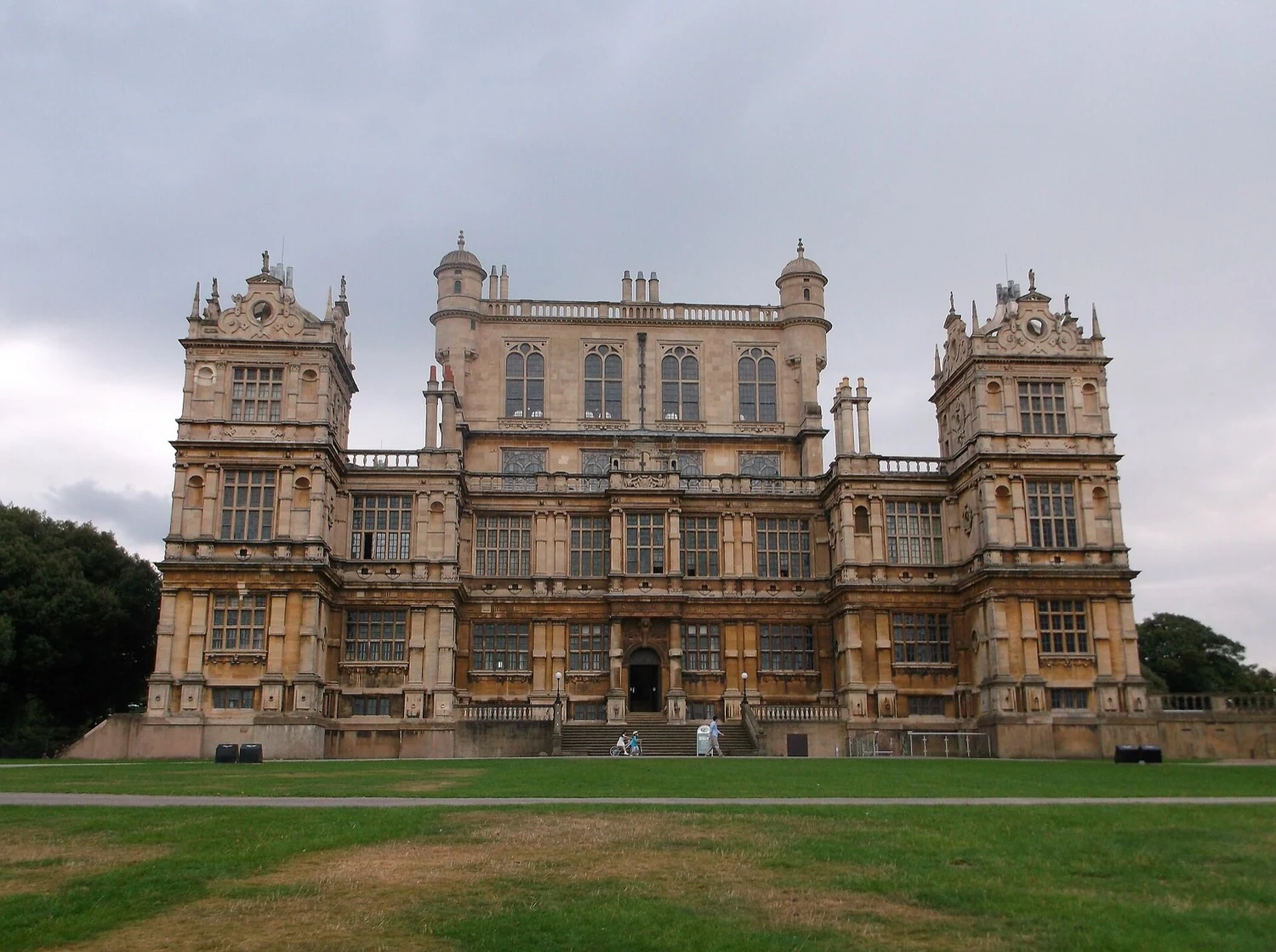
To see: this "prodigy house" built by Robert Smythson for Francis Willoughby (1580-1588) wears its decoration like a lesson in humanism. On the corner towers, look for the classical busts set in circular niches, each framed by a strapwork cartouche — gods, philosophers and scholars of antiquity (a portrait of Charles I was later slipped in among them). The gables crowning the turrets twist into Flemish strapwork, bands of stone curled like cut leather, taken straight from the pattern books of Vredeman de Vries. Superimposed pilasters, round-arched niches, classical balustrades: every ornament speaks of an Italy imagined by way of Flanders. At the summit, the great central prospect room makes the house a crown of carved stone.
Did you know?
The strapwork that reigns at Wollaton is not Italian but Flemish: Smythson drew on the engravings of Hans Vredeman de Vries (Variae architecturae formae, 1563). The Renaissance thus reached England by a northern detour — the antique reread through Antwerp, not Florence.
Info
- Architect: Robert Smythson (buried in Wollaton church); patron: Sir Francis Willoughby.
- Decoration: busts in cartouche niches (corner towers), Flemish strapwork gables, superimposed pilasters, classical balustrades.
- Style: classical Mannerism of Flemish origin.