
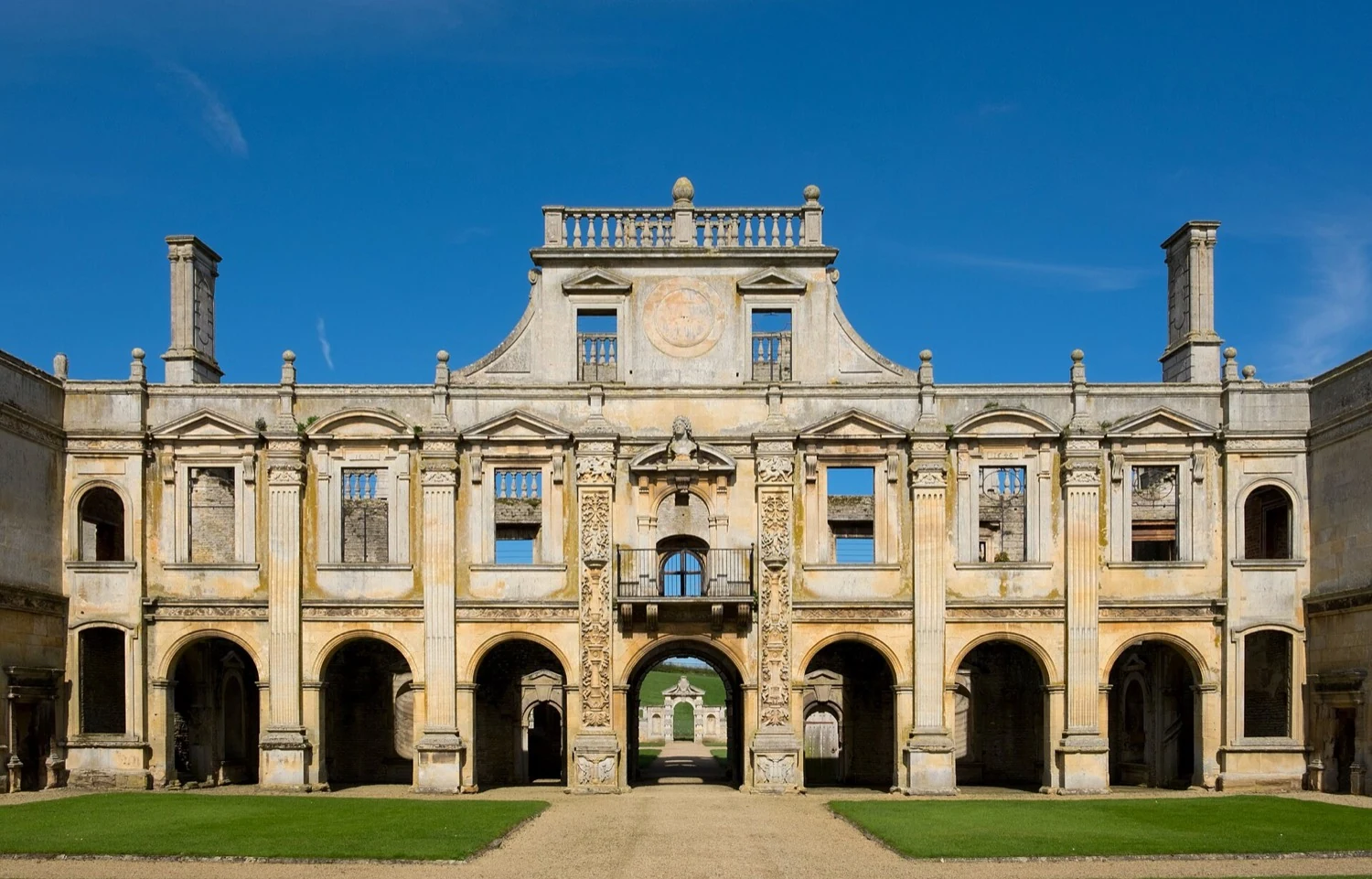
To see: pass the porch and step into the inner courtyard — this is where the sculpture bursts out. All four sides are articulated by a series of giant pilasters, carved up to their finely chiselled capitals with a delicate Renaissance vocabulary; a carved frieze runs right around the quadrangle, between the tall windows flanked by fluted columns. A telling, unique detail: each capital is topped by a narrow frieze, then a miniature colonnette crowned with a ball — a mason's invention that multiplies the orders endlessly. The great porch-frontispiece concentrates the classical ambition of the whole. Begun around 1570 for Sir Humphrey Stafford, the house soon passed to Elizabeth's favourite, Sir Christopher Hatton.
Did you know?
Kirby's decoration is a masons' manifesto rather than an Italian import: the local stone-carving Thorpe family deploys a highly personal reading of the orders — hence those stacked colonnettes prescribed by no treatise. Inigo Jones would work here later (c.1638-1640) on other parts; the carved core remains Elizabethan.
Info
- Patrons: Sir Humphrey Stafford, then Sir Christopher Hatton; masons: the Thorpe family.
- Decoration: giant pilasters, carved Renaissance capitals, continuous courtyard frieze, porch-frontispiece, characteristic ball-topped colonnettes.
- Later additions (windows, attic) attributed to Inigo Jones's circle, c.1638-1640.