
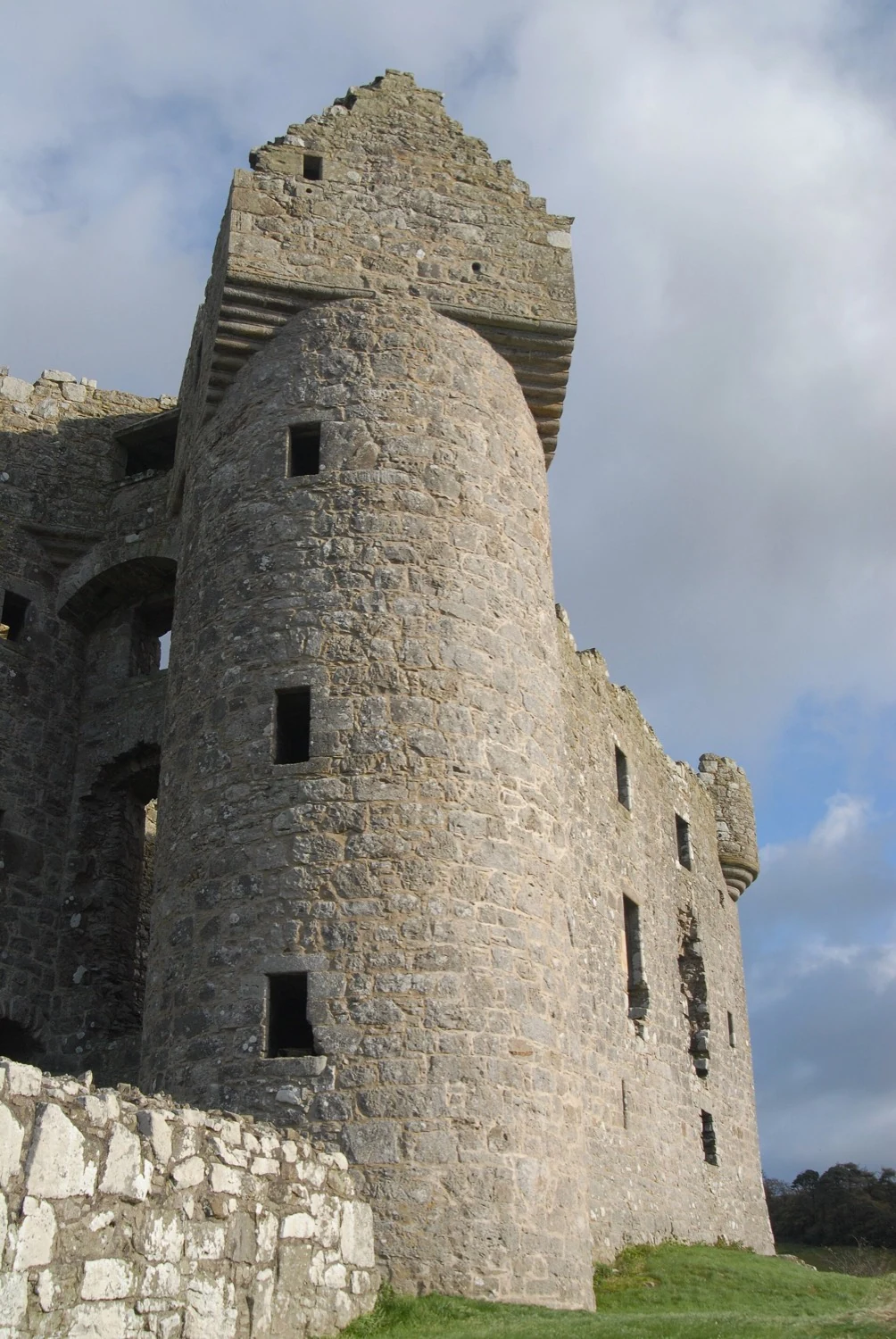
To see: at the end of a wooded lane, the tall tower-house of Monea, the best-preserved of all the Plantation castles of Ulster, still ringed by its bawn. Let your eye climb the two towers of the entrance front: their tops are carried on a run of moulded corbels, each course of stone oversailing the one below — the Scottish corbelling technique that lets round towers be capped with square caphouses set diagonally and roofed with crow-stepped gables. This whole vocabulary — corbelling, caphouses, stepped gables — comes straight from the tower houses of Scotland. The castle was built around 1618 by the rector of Devenish, the Reverend Malcolm Hamilton, a Scot promoted Archbishop of Cashel in 1623; its bawn with two circular flankers was added about 1622. Monea's "sculpted decoration" is thus wholly architectural: it is the masonry itself, through its corbels and gables, that signs the aesthetic of the Plantation.
Did you know?
Monea's round towers capped with diagonal square caphouses look so Scottish that they are often compared to Claypotts Castle near Dundee: the Plantation quite literally transplanted a piece of Scotland into the heart of Fermanagh.
Info
- Tower-house built c. 1618 by the Rev. Malcolm Hamilton (bawn c. 1622).
- Scottish corbelling carrying crow-stepped caphouses.
- The most complete and best-preserved of Ulster's Plantation castles.
- Exterior; attacked in the 1641 rebellion. monument_lié: monea-castle.
Fiches écartées (SOURCES INSUFFISANTES / non vérifiables en l'état)
UKS-041 — Tombeau de Rhys ap Gruffydd et Lady Margaret (St Davids Cathedral)
Écartée. Aucun tombeau Renaissance (XVIe s.) « Rhys ap Gruffydd et Lady Margaret » n'est attesté à la cathédrale de St Davids. L'objet décrit paraît confondre deux choses : l'effigie médiévale du Lord Rhys ap Gruffudd (mort en 1197), qui est un gisant du XIVe siècle — donc hors période — et dont l'épouse était Gwenllian ferch Madog (et non « Margaret »). Datation, personnage et conjoint ne concordent pas avec une œuvre de 1500-1625. Sources : Wikipedia — Rhys ap Gruffudd ; Cadw — Lord Rhys ap Gruffydd.
UKS-043 — Monuments Mansel (St Illtyd's Church, Oxwich)
Écartée. Les grands monuments funéraires Mansel de la Renaissance (Sir Rice Mansel, mort en 1559, etc.) se trouvent à Margam Abbey Church, et non à Oxwich. À St Illtyd's d'Oxwich, la seule sculpture funéraire notable est une effigie de chevalier et dame du XIVe siècle (niche du mur nord), médiévale et d'identification incertaine — pas un « ensemble Mansel » Renaissance. Attribution/lieu erronés. Sources : Wikipedia — Rice Mansel ; Howard Williams — The Mansel Tombs of Margam Abbey Church ; History Points — St Illtyd's Church, Oxwich.
UKS-046 — Monument de Sir Edward Carne (Cowbridge)
Écartée. Sir Edward Carne (v. 1496-1561), diplomate, mourut à Rome et y fut enterré (tablette commémorative dans le cloître de San Gregorio Magno al Celio). Il avait certes demandé par testament (1560) qu'un tombeau soit dressé près de celui de son père à Cowbridge, mais aucune source ne confirme qu'un tel monument ait été réalisé ni ne subsiste dans l'église de Cowbridge (par ailleurs nommée Holy Cross et non « St Mary's » dans le JSON). Objet non attesté sur place. Sources : Wikipedia — Edward Carne ; History of Parliament — Carne, Sir Edward ; Wikipedia — Church of the Holy Cross, Cowbridge.
UKS-048 — Sculpture héraldique Tudor de Carrickfergus Castle
Écartée. Deux recoupements (article Wikipedia du château + recherche ciblée) ne font apparaître aucune sculpture héraldique Tudor / armes royales du XVIe siècle documentée à Carrickfergus. Les interventions du XVIe s. attestées sont des aménagements d'artillerie (gunports évasés, embrasures pour canon), non un décor héraldique sculpté. L'objet « sculpture héraldique Tudor » n'est pas vérifiable en l'état. Sources : Wikipedia — Carrickfergus Castle.