
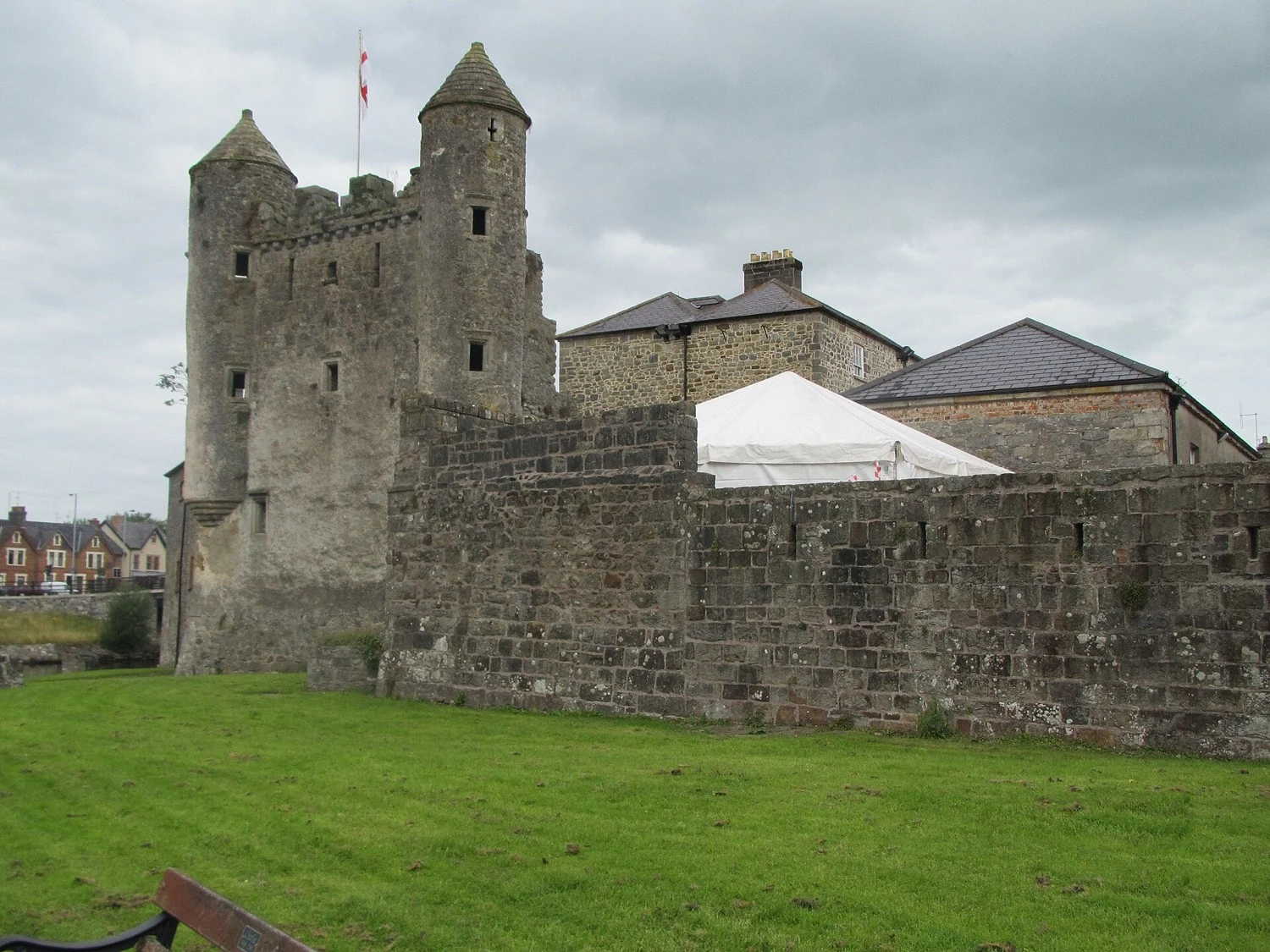
To see: rising straight from the water, the twin-turreted front of Enniskillen's Watergate, crowned with two conical-roofed turrets carried on stone corbelling. The motif is not Irish: these slender turrets echo the architecture of Scotland, homeland of the new settlers of the Ulster Plantation. The Watergate was completed in 1614 for Captain (soon Sir) William Cole, a Londoner made constable of the castle and the driving force behind the new town of Enniskillen. The sculpture here is architectural — rows of moulded corbels that throw out the tops of the towers, angle bartizans grafted onto the medieval Maguire curtain wall, masonry lines that compose, above the river, one of the most famous images of the Plantation. It is stone put to a new language, planted by colonisation in the heart of Gaelic Fermanagh.
Did you know?
The castle was originally a stronghold of the Maguires, Gaelic lords of Fermanagh, before it passed to William Cole at the Plantation. The Scottish Watergate was thus grafted onto a Gaelic fortress — two worlds layered in one stone.
Info
- Watergate completed 1614 for Captain William Cole (knighted 1617).
- Corbelled conical turrets + bartizans, Scottish in inspiration.
- Plantation architectural sculpture grafted onto the medieval Maguire castle.
- Exterior; the castle now houses the Fermanagh County Museum. monument_lié: enniskillen-castle.