
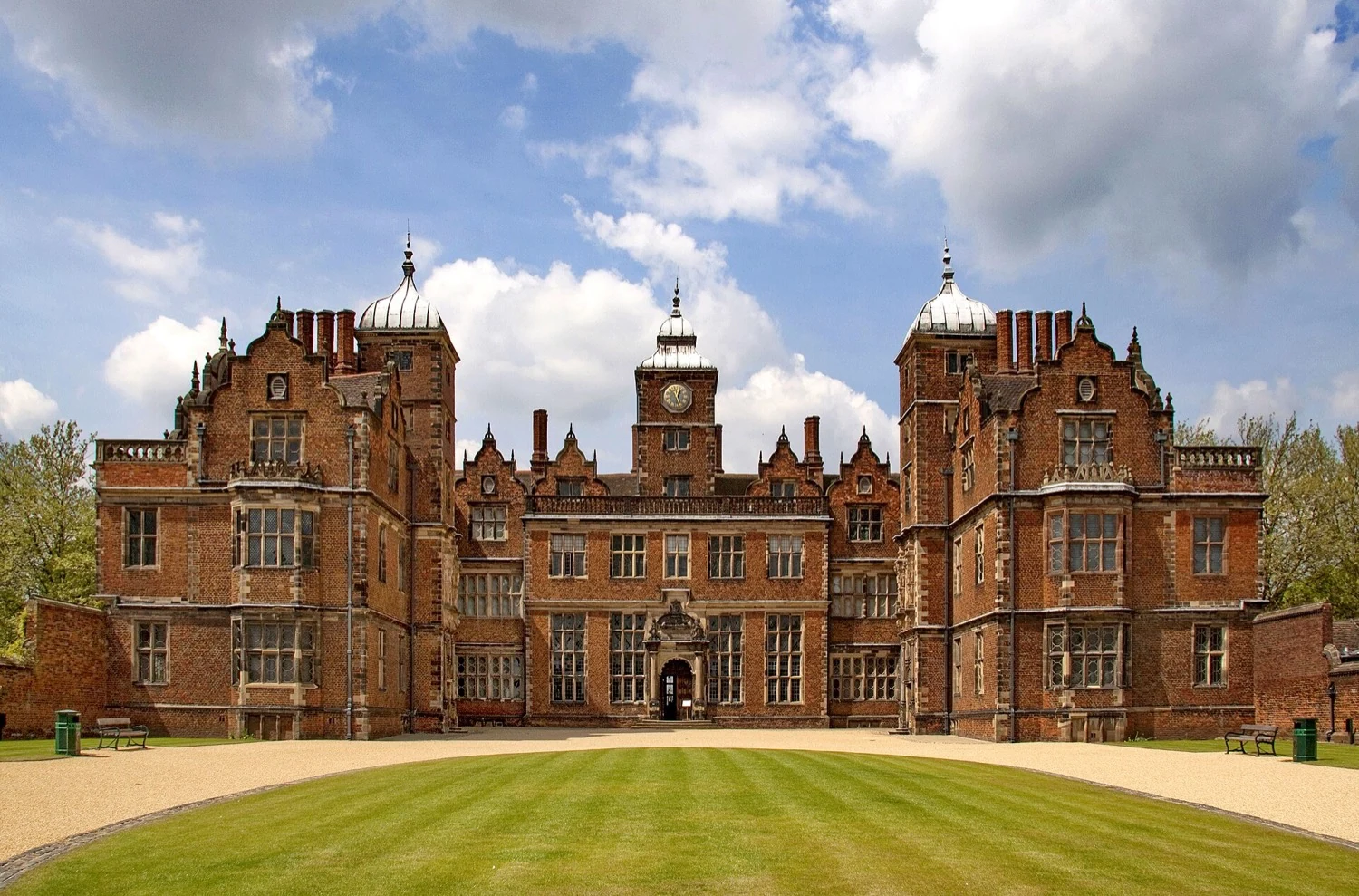
In what is now a Birmingham park stands Aston Hall, a vast brick mansion built from 1618 to 1635 for Sir Thomas Holte. It is one of the last great Jacobean houses — the "prodigy houses" the high nobility raised to dazzle, and here to hold rank on the threshold of a century of war.
A Jacobean palace in brick
Look at the H-plan and the broken skyline of gables, turrets and chimneys: Aston Hall unfolds the full Jacobean vocabulary, mixing classical symmetry with Flemish fancy. Inside, don't miss the Long Gallery of nearly 40 metres, a gallery for walking and for show, and the carved great oak staircase. The wrought plaster ceilings, monumental chimneypieces and panelling declare the ambition of a man who meant to receive a king — which he did.
A cannonball in the stair
In 1642, at the outbreak of the Civil War, Sir Thomas Holte, loyal to the king, gave Charles I a night's lodging at Aston Hall. The house was soon besieged by Parliamentary troops: look, in the great stairwell, for the mark left by a cannonball — a kept scar from the day war entered the house. Aston Hall became, in the nineteenth century, one of the first great country houses to open as a public museum. Don't miss: the Long Gallery, the scarred staircase, the plaster ceilings, the Great Hall.
Did you know?
When Aston Hall opened to the public in 1858, Queen Victoria herself came to inaugurate the park: it was among the very first historic houses in England bought by a city to serve as a museum open to all. The palace built to dazzle an elite became a Sunday garden for the workers of Birmingham.
Info
Aston Hall is in Aston, Birmingham (West Midlands); a museum run by the city, house and park open to visitors. Hours to be checked.