
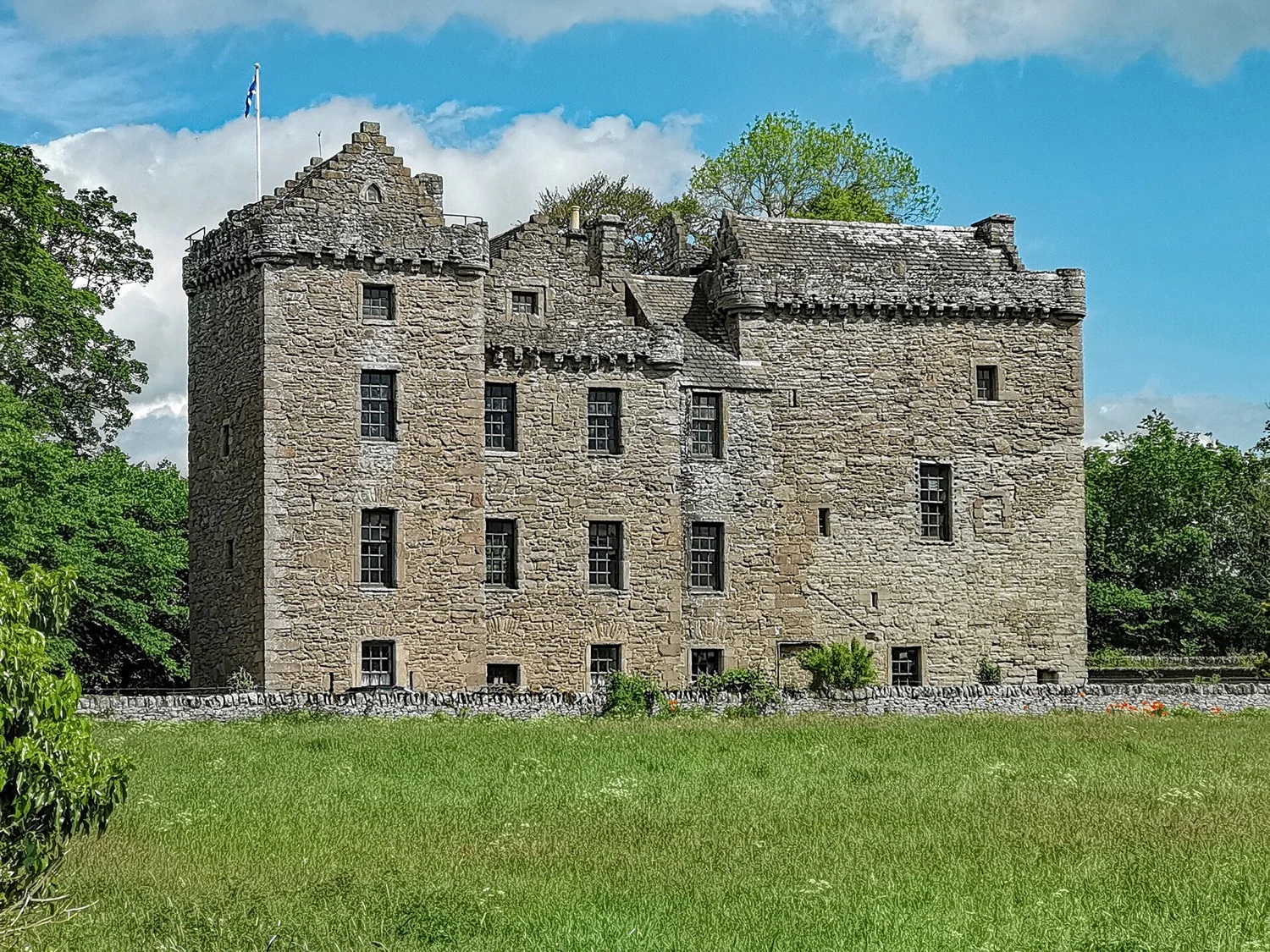
Near Perth, Huntingtower Castle (formerly Ruthven Castle) was the scene of one of the most famous coups of Renaissance Scotland: the Ruthven Raid, which saw the young King James VI seized. It also holds one of the oldest painted ceilings in Scotland.
The Ruthven Raid
A stronghold of the Ruthvens, the castle was the place of the Ruthven Raid (22-23 August 1582): William Ruthven, 1st Earl of Gowrie, seized and held here the young James VI (15 years old), who only escaped at St Andrews on 27 June 1583. This royal hostage-taking, meant to control power, lastingly marked the king. After the later Gowrie House conspiracy (1600), the very name of Ruthven was proscribed and the castle renamed Huntingtower in 1600.
A pioneering painted ceiling
Beyond the political drama, Huntingtower preserves one of the oldest tempera painted ceilings in Scotland (around 1540), a jewel of the Scottish decorative Renaissance, long hidden and only rediscovered in 1912-1913. To see: the painted ceiling of the east tower, the two close independent towers and the famous 'Maiden's Leap' between them.
Did you know?
Between the two close towers of Huntingtower lies a gap that legend names the 'Maiden's Leap': a Ruthven maiden, surprised in her lover's room, is said to have leapt across it in desperation to regain her chamber and escape scandal. A gallant anecdote from a castle known above all for the seizing of a king.
Notes
Huntingtower Castle lies near Perth; a site in the care of Historic Environment Scotland. Hours to check.
Quiz
- Which event of 1582 took place here?
- The Ruthven Raid (seizing of James VI)
- The defeat of the Armada
- The coronation of Mary Stuart
- What does Huntingtower preserve, dating from around 1540?
- One of the oldest painted ceilings in Scotland
- An astronomical clock
- A library of manuscripts
- Why was the castle renamed in 1600?
- The Ruthven name was proscribed after the Gowrie conspiracy
- It was sold to England
- It changed county