
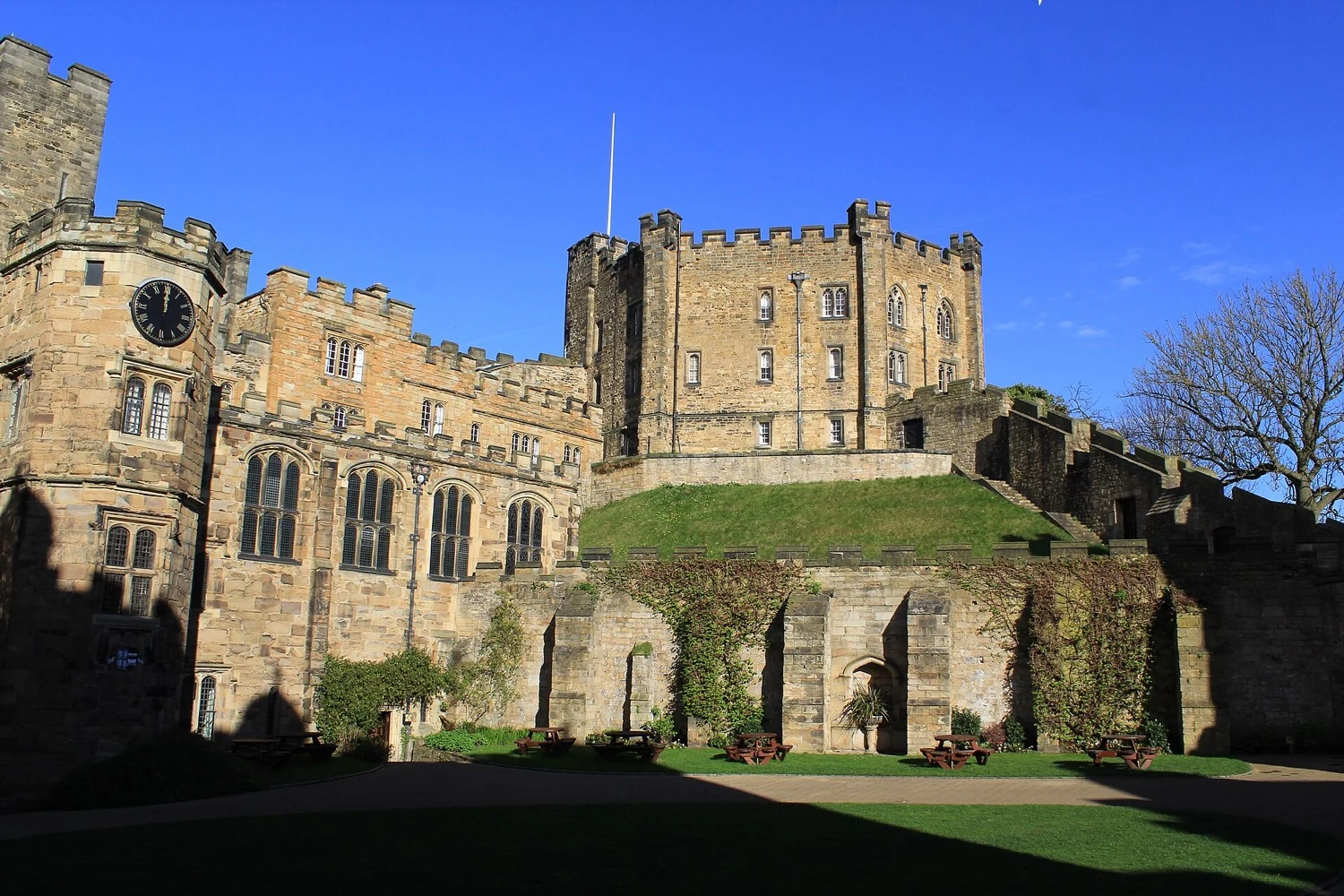
Standing opposite the cathedral on its rocky spur, Durham Castle was, for eight centuries, not an ordinary fortress but the palace of the prince-bishops of Durham — prelates who ruled the North like temporal princes. In the Renaissance, one of them left the mark of his century here.
The palace of the prince-bishops
Founded by the Normans, the castle served as the residence of the bishops of Durham, endowed with near-royal powers in their "county palatine". Over time the fortress became a palace: Great Hall, kitchens, apartments. Look, beyond the medieval shell, for the sixteenth-century additions that brought the Renaissance taste here.
The mark of Bishop Tunstall
Cuthbert Tunstall, bishop from 1530 to 1559 — a humanist, friend of Erasmus and Thomas More, one of the few to cross all the religious reversals of the century without losing his head — had a gallery built at the castle and reworked the chapel in the style of his time. These Tudor elements, grafted onto the old palace, are the legible trace of the Renaissance at Durham. The castle now houses a college of the university. Don't miss: Tunstall's gallery, the Tudor chapel, the Great Hall, the Black Staircase (seventeenth century), the view of the cathedral (the whole a World Heritage Site).
Did you know?
Cuthbert Tunstall, who beautified Durham Castle, was one of the most astonishing survivors of the century: a bishop under Henry VIII, he first refused the break with Rome, then submitted, served Mary the Catholic, then was deposed by Elizabeth the Protestant — and died, very old, without ever being executed, a rare feat for a prelate of his time. His gallery at Durham is the mark of a man who built while others climbed the scaffold.
Info
Durham Castle stands on the Durham peninsula, opposite the cathedral (County Durham); a college of the University of Durham, guided tours according to the university calendar. Cathedral and castle together a UNESCO World Heritage Site. Access to be checked.