
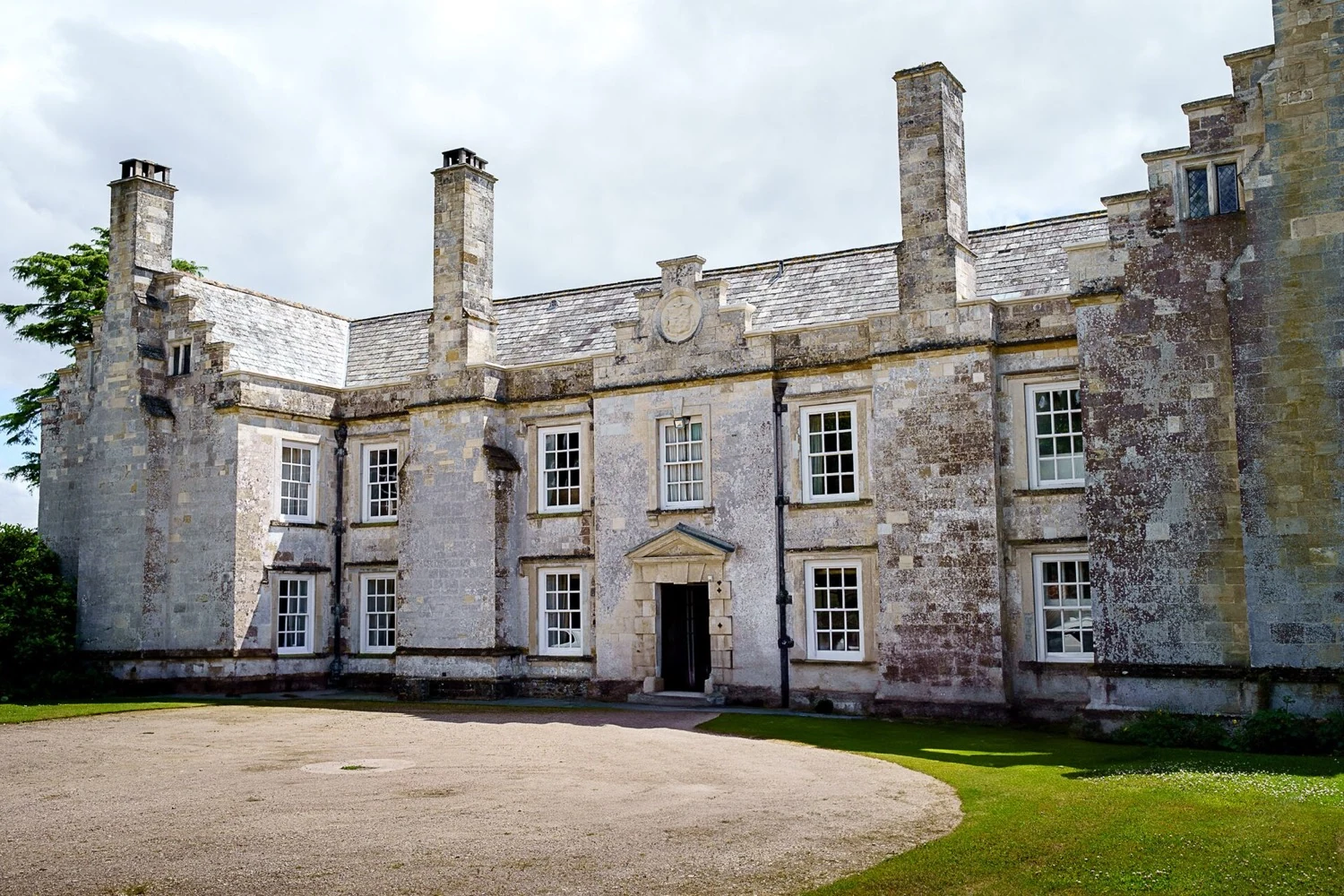
Near Ottery St Mary in Devon, Cadhay is a Tudor manor at once modest and refined, whose small inner court carries one of the most eloquent programmes of Renaissance England: the four Tudor sovereigns keeping watch, in stone, over the house.
A manor built on monastic lands
Cadhay was raised in 1550 by John Haydon, a lawyer enriched — like so many — by the redistribution of monastic lands after the Dissolution. A careful man, he kept the Great Hall of an earlier manor: its fine timber roof, dated 1420-1470, can still be seen in the "Roof Chamber". Around it he built a new house of stone and flint, in the Tudor taste. The house thus tells the great transfer of wealth of the sixteenth century: from the Church to the men of law.
The Court of the Sovereigns
John's nephew, Robert Haydon, enlarged the house in the late sixteenth century by adding a Long Gallery, which closed the fourth side and created a small inner court. Look at its façades: a chequer of flint and stone, and above all, set over the four doors, the statues of the last four Tudors — Henry VIII, Edward VI, Mary I and Elizabeth I. Hence the name "Court of the Sovereigns": to display the monarchs was to display one's loyalty and rank. Don't miss: the Court of the Sovereigns and its four statues, the Long Gallery, the medieval-roofed Great Hall, the gardens.
Did you know?
To place the portraits of the four Tudor sovereigns in one's court was no mere decoration: under a dynasty that had changed its official religion three times in twenty years, to display Henry, Edward, Mary AND Elizabeth together was to proclaim a careful loyalty to the Crown whatever its faith. At Cadhay, Renaissance ornament is also a political statement cut in stone.
Info
Cadhay is near Ottery St Mary (Devon); a private house, house and gardens open to the public on certain summer days and by appointment. Hours to be checked.