
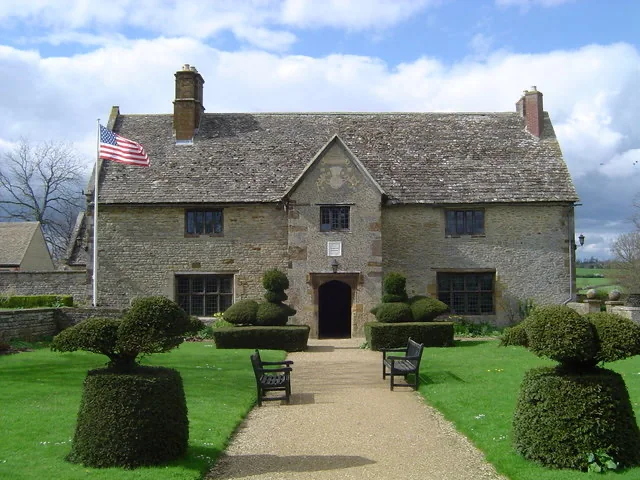
In the Northamptonshire countryside, Sulgrave is a modest but perfect Tudor manor built in the mid-sixteenth century. Its fame lies not in its size but in its bloodline: it is the house of the Washingtons, the family from whom, two centuries later, the first president of the United States would descend.
The house of a Tudor new man
In 1539 Lawrence Washington, a wealthy wool merchant and mayor of Northampton, bought the manor of Sulgrave — land only just seized from a priory in Henry VIII's dissolution of the monasteries. On this former Church land returned to the market, he raised a stone manor to match his success: a great hall, an entrance porch, mullioned windows. Look above the door: the Washington arms are carved there — three mullets (stars) above two bars. Many see in them a distant foreshadowing of the stars and stripes.
A house that became a symbol
Sulgrave illustrates the rise of the Tudor "new men": enriched merchants who, seizing the redistribution of Church property, settled into the gentry and built houses. A descendant, John Washington, emigrated to Virginia in 1656; his great-grandson was George Washington. Restored in the early twentieth century as a symbol of Anglo-American friendship, the manor is open to visitors. Don't miss: the Tudor great hall, the porch with the Washington arms, the old kitchen, the garden.
Did you know?
The Washington arms carved over Sulgrave's porch — three stars above two red bars — are so close to the future American flag that legend credits them as its inspiration. Nothing proves it, but the idea is irresistible: the flag of the United States tracing back to the porch of a small English manor built on monks' land.
Info
Sulgrave Manor is at Sulgrave, near Banbury (Northamptonshire); a house-museum open to the public, run by a trust. Seasonal hours to be checked.