
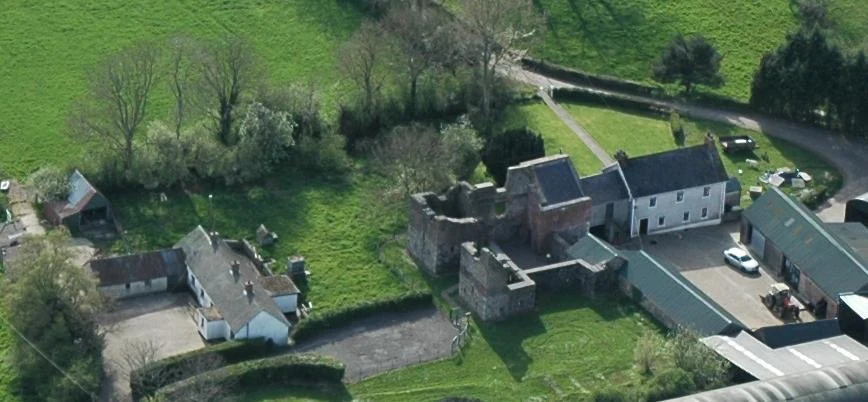
On the shore of Lough Neagh, near Coalisland, in County Tyrone, Mountjoy Castle raises its red-brick remains. A campaign fort erected during the Nine Years' War, it was planted at the very heart of the territory of Hugh O'Neill, the great Gaelic chief — a direct prelude to the Plantation.
A fort of the Nine Years' War
Mountjoy was built around 1602-1605 by Charles Blount, Lord Mountjoy, Lord Deputy of Ireland, during the final phase of the Nine Years' War (1594-1603). This great Gaelic revolt, led by Hugh O'Neill, Earl of Tyrone, had nearly driven the English out of Ulster. To break it, Mountjoy adopted a methodical strategy: to plant forts in the middle of enemy territory, cutting O'Neill off from his resources. Mountjoy Castle, erected 'at the heart' of O'Neill's country, on Lough Neagh, was one of those masterpieces of the Tudor reconquest — an English outpost in Gaelic land.
The prelude to the Plantation
The building of Mountjoy illustrates the direct link between the military conquest and the Plantation. By breaking the resistance of Hugh O'Neill through a war of attrition and forts, Lord Mountjoy prepared the ground: the Gaelic defeat, then the Flight of the Earls (1607), opened the way to the colonisation. The fort, built of local red brick from Coalisland, dominated Lough Neagh and watched the movements of the O'Neills. Mountjoy is thus the link that connects the two great moments of the Ulster of our period: the war that brought down the Gaelic order, and the Plantation that replaced it. To see: the rectangular block with four pointed corner towers (with gun loops), the red brick of Coalisland, the position dominating Lough Neagh.
Did you know?
The name of the castle comes from that of its builder, Charles Blount, Lord Mountjoy — the man who defeated Hugh O'Neill and ended the Nine Years' War. His strategy was of a ruthless efficiency: rather than seeking pitched battle, he systematically ravaged O'Neill's territory, destroying crops and cattle to starve the rebellion, while planting forts like Mountjoy to lock down the country. This 'war of hunger' broke the greatest Gaelic revolt in Irish history — and opened the door to the Plantation.
Notes
Mountjoy Castle lies at Brockagh, shore of Lough Neagh, near Coalisland, County Tyrone; remains run by the NI heritage bodies, accessible. GPS to confirm. Hours to check.
Quiz
- Who built Mountjoy Castle (c. 1602-1605)?
- Charles Blount, Lord Mountjoy
- Hugh O'Neill
- Sorley Boy MacDonnell
- At the heart of which Gaelic chief's territory was it planted?
- Hugh O'Neill, Earl of Tyrone
- The Maguires
- The MacDonnells
- Which event did Mountjoy prepare?
- The Plantation (via the Gaelic defeat)
- The Armada
- The Henrician Reformation