
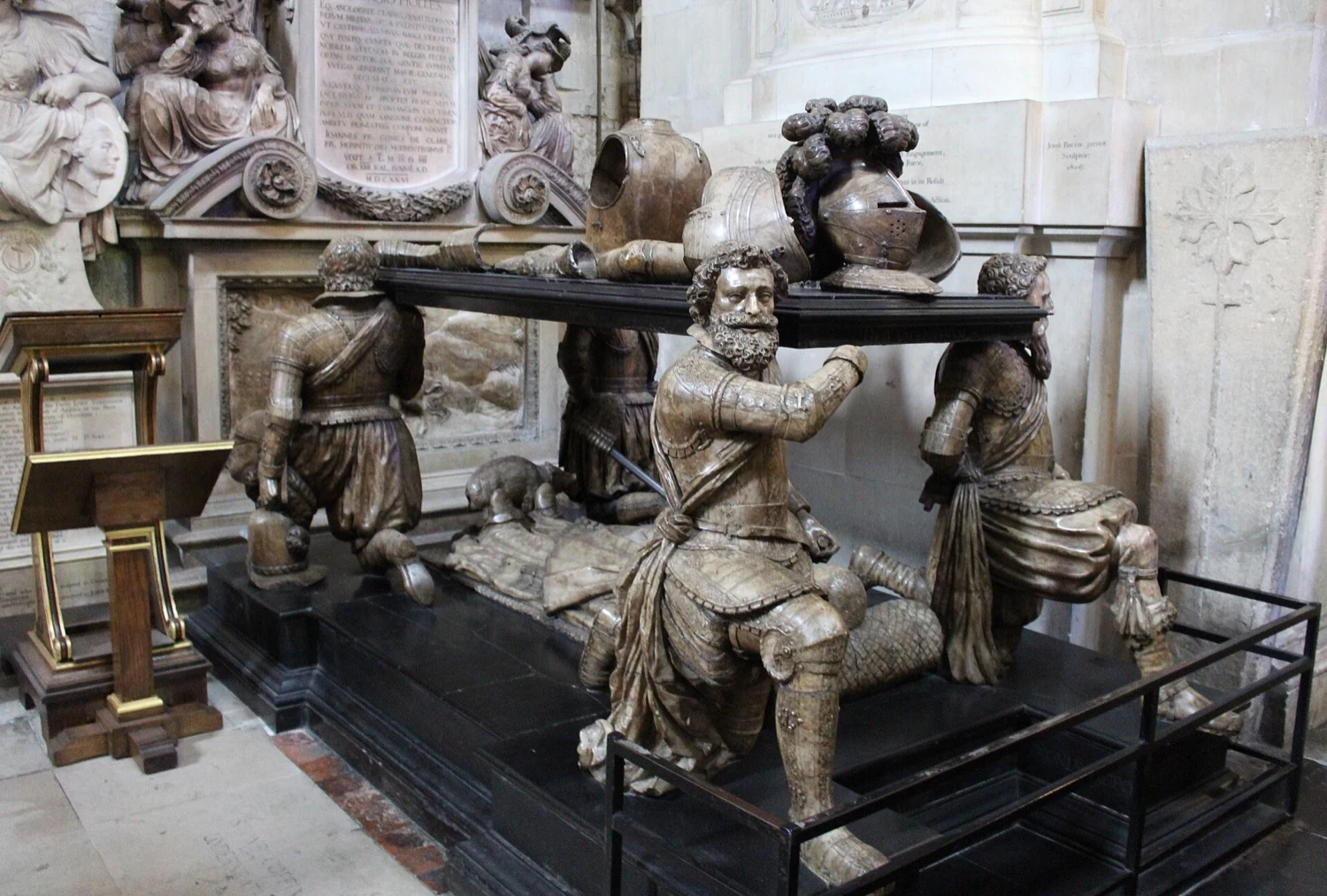
To see: look first not at the dead man but at what he no longer wears. Francis Vere, a soldier who died in 1609 after long campaigns in the Low Countries, lies in civilian dress on a thin carved rush mattress, unarmed, his hands free. Above him a heavy flat slab is held aloft by four life-sized armoured knights, kneeling at each corner and bracing their shoulders under its weight. And on that slab, no figure at all — only the knight's full suit of armour, laid out piece by piece as on a bed of state. The whole meaning lives in that gap: the peaceful, stripped body below; the warrior's gear above, carried by his own men. Pale alabaster sets the effigy off against black marble, and the eye climbs from the bowed knights' faces to the carved steel overhead. The design is borrowed straight from the tomb of Count Engelbert II of Nassau at Breda, which Vere could have seen during his service in Flanders.
Did you know?
The monument is now attributed to the sculptor Isaac James rather than Maximilian Colt: the four knights' faces closely match those on the nearby Norris monument from the same workshop.
Info
Chapel of St John the Evangelist, north transept, Westminster Abbey. Effigy in civilian dress; carved armour laid on the upper slab; four kneeling knight-caryatids. Model: tomb of Engelbert II of Nassau, Breda.