
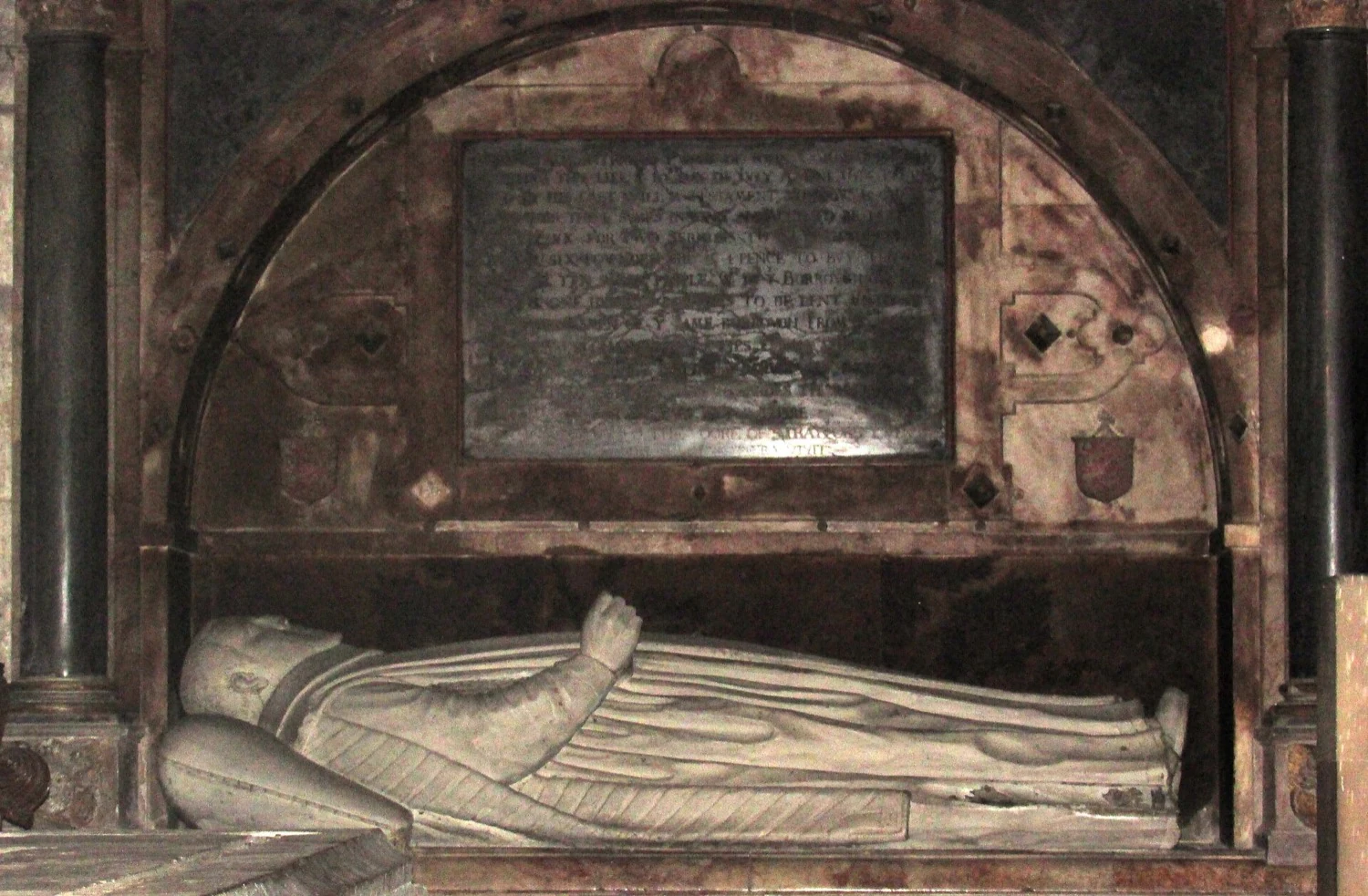
To see: in the chancel of Holy Trinity, only steps from Shakespeare's monument, a gentleman lies on his back, hands joined, beneath a shallow arched canopy on Corinthian columns. This is John Combe, one of Stratford's wealthiest men — landowner and moneylender — who died in 1614. His will called for a tomb costing sixty pounds, raised within a year: the result is this crisp alabaster chest, flanked by obelisks and crowned with an armorial panel. Look closely at the drapery and the face — the same hand as Shakespeare's bust, for the work is attributed to Gerard Johnson the Younger of the Southwark workshop, who also made the poet's famous monument close by. Two neighbours in stone, shaped by the same chisel.
Did you know?
Combe was Shakespeare's friend and received five pounds in the playwright's will. Tradition even credits Shakespeare with a mocking epitaph on Combe's usury — a posthumous joke between friends, though its authenticity is debated.
Info
- Recumbent effigy, hands in prayer, arched canopy on Corinthian columns.
- Obelisks and coat of arms: the standard Jacobean funerary vocabulary.
- Compare with Shakespeare's monument (same workshop) in the same church.